
Last updated on June 26th, 2026
💧✨ The Baths of Doña María de Padilla — Mystery, Beauty & Legend in the Alcázar of Seville
📲 Explore the Alcázar of Seville with our official guides
Discover the Royal Alcázar with private official guides and special attention to its most mysterious and evocative spaces: the Baths of Doña María de Padilla, the Patio del Crucero, legends of King Pedro I, gardens, palaces, hidden symbolism and artistic details.
✉️ info@visitarsevilla.com
💬 Direct WhatsApp
📱 Instagram of VisitarSevilla.com
💡 Our philosophy: The Alcázar is not only a palace. It is a world of water, power, beauty, desire, myth and memory. The Baths of Doña María de Padilla show this better than almost any other corner: a place where architecture becomes legend.
🌟 Why the Baths of Doña María de Padilla are so special
💧 One of the iconic images of Seville
🌿 A hidden gem beneath the Garden of the Dance
The Baths are accessed through a barrel-vaulted corridor, decorated with traditional Sevillian tiles, which leads from the Garden of the Dance. The descent already prepares the visitor for something different: a cooler, quieter and more mysterious atmosphere.
Before reaching the water, you encounter a Mannerist-style courtyard with a gallery of arches and columns decorated with grotesques. The Fountain of Troy appears as part of this theatrical transition between garden, palace and underground space.
❤️ My insight: What I love about this place is that visitors often stop speaking when they enter. The Baths impose silence naturally. You feel that you are no longer simply visiting a monument, but entering a secret.
✨ A place of silence, shadows and reflection
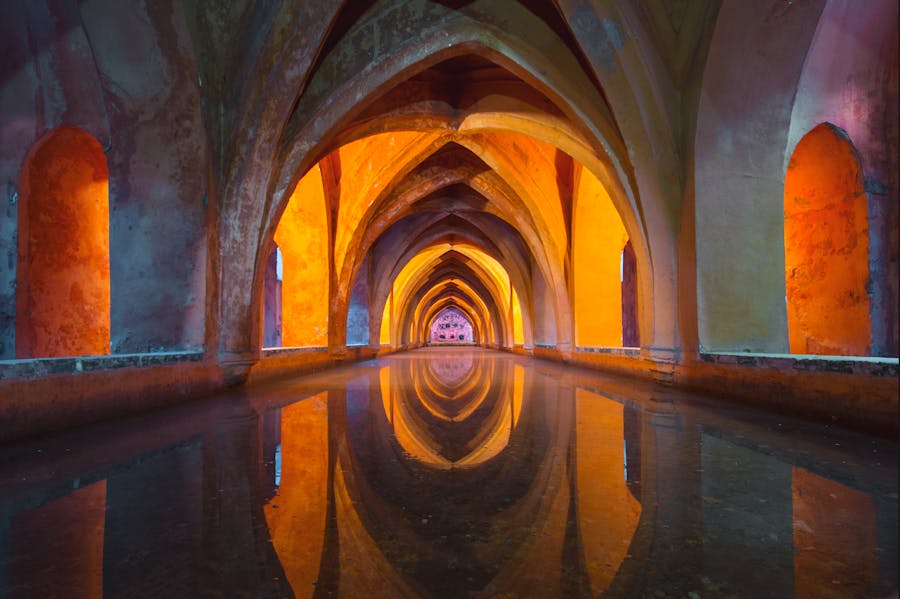
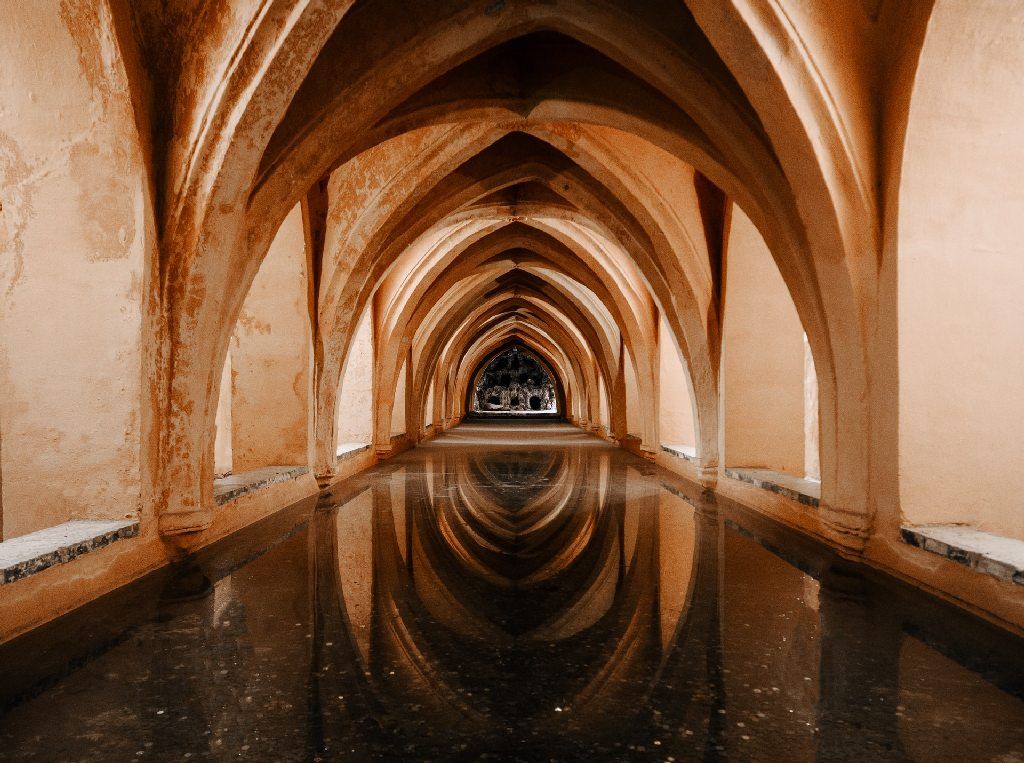
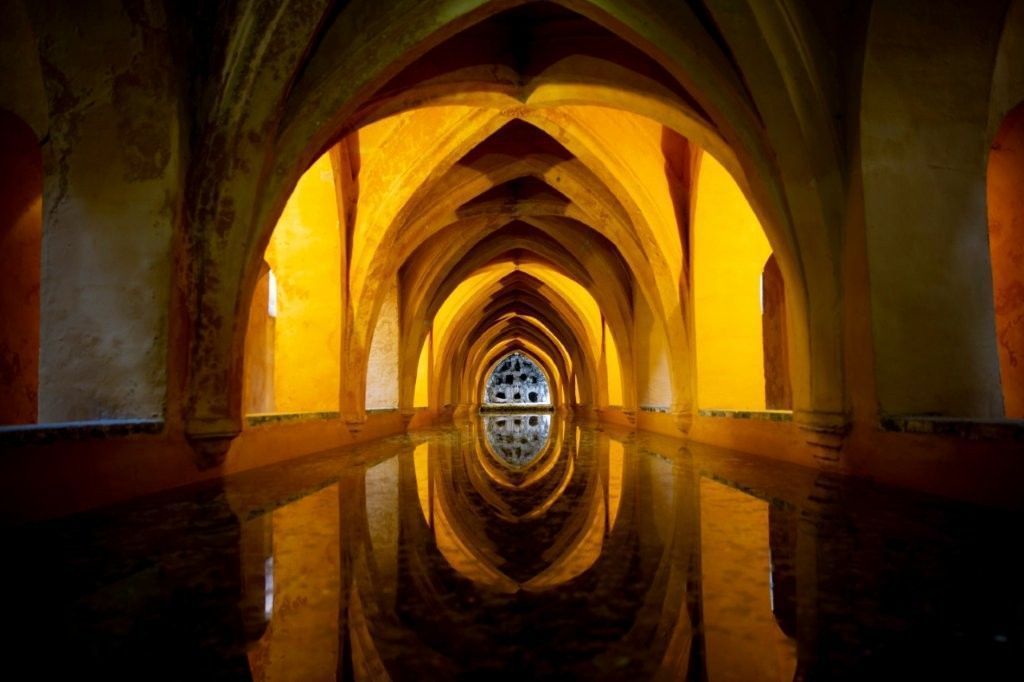
What strikes visitors most is the mystical atmosphere of the Baths. Soft natural light filters through small openings, casting shadows and reflections over the surface of the water.
The three naves, the vaults and the large cistern create a dreamlike mirror where architecture seems to dissolve into reflection. It is one of the most serene and photogenic corners of the Alcázar.
This is why the Baths have become one of the iconic images of Seville: they are beautiful, mysterious, immediately recognizable and emotionally powerful.
📍 Location: The Baths are located near the Fountain of Mercury, down a flight of stairs. On many maps of the Alcázar, they appear as one of the essential hidden stops of the palace.
👑 Doña María de Padilla: history, love and legend
The Baths are named after Doña María de Padilla, the legendary mistress — and later, according to royal declarations, wife — of King Pedro I of Castile.
Popular tradition imagined this secluded underground place as the private bathing space of María de Padilla. Romantic legends describe her entering the water in silence, hidden from the world, surrounded by candlelight and mystery.
Whether or not the legend is historically exact, it has become part of the emotional power of the place. The name of María de Padilla gives the Baths a feminine, secret and almost theatrical aura.
👑 Local feeling: Seville loves stories where history and legend touch each other. The Baths of Doña María de Padilla are one of the best examples: a real architectural space transformed by imagination.
🌎 María Padilla and her strange Brazilian afterlife
One of the most surprising stories linked to the name María Padilla is found far from Seville, in Brazil.
In certain Afro-Brazilian and popular spiritual traditions, the name Maria Padilha became associated with a powerful feminine entity, often linked to the world of Pomba Gira, ritual, desire, protection, crossroads and popular devotion.
This Brazilian figure is not the same as the historical Doña María de Padilla of Castile. But the transformation of the name is fascinating: a medieval woman linked to the court of King Pedro I becomes, through the strange pathways of oral culture and popular belief, a symbolic presence in another continent.
🔎 A fascinating connection: This is the kind of story that makes cultural visits so rich. A name born in medieval Iberia travels through legend, colonial memory and popular religion until it becomes part of Brazilian spiritual imagination.
During our visits, we can speak about this curious and unexpected connection with sensitivity and respect, as part of the broader cultural afterlife of María de Padilla.
🏛️ Layers of history and art
Beyond romantic lore, the Baths are in fact an Almohad cistern dating from the 12th–13th centuries. Later, during the Gothic period, the space was transformed under King Alfonso X, who ordered the addition of ribbed vaults.
Archaeological studies show that these underground chambers belonged to the original ground floor of the Patio del Crucero. What today feels like a basement was once part of a different architectural level.
On the lateral walls and corridors, traces of fragile Renaissance frescoes from the 16th century can still be seen. These delicate works, affected by humidity, remind us that the space was not only functional but also decorated and visually meaningful.
🏺 Almohad origin: a water cistern from the Islamic period of Seville.
🏛️ Gothic transformation: ribbed vaults added under Alfonso X.
🎨 Renaissance traces: remains of fragile 16th-century frescoes.
💧 Water architecture: engineering, storage, cooling and symbolic beauty.
🌫️ Atmosphere: humidity, darkness and reflection create a uniquely evocative space.
🌡️ A cool refuge in the heart of Seville
After the devastating Lisbon earthquake of 1755, the Baths were filled in as part of structural reinforcement works. The original Almohad structures were partly buried beneath later Baroque renovations, effectively transforming the space into a basement.
Thanks to the air vents and openings from the Patio del Crucero above, the Baths maintain a cooler temperature than many other areas of the palace. In a city as hot as Seville, this coolness adds to the sensation of refuge and mystery.
In later centuries, the space was also used for practical purposes, including storage, showing how architecture can pass from royal prestige to utility, and then back again to beauty through modern heritage interpretation.
🏰 Architectural harmony
Today, the Baths of Doña María de Padilla stand as a breathtaking blend of Almohad engineering, Gothic architecture and Renaissance artistry.
What makes the space so powerful is not only its age, but the harmony of its elements: water, darkness, arches, vaults, reflection and silence. It feels both architectural and emotional.
It is one of those places where visitors understand that the Alcázar is not a single monument, but a layered world shaped by different cultures, kings, artists, restorations and legends.
🗺️ How we include the Baths in our Alcázar tours
🏰 Royal Alcázar overview: Islamic, Mudéjar, Gothic, Renaissance and Baroque layers.
👑 King Pedro I: power, politics, palace culture and legends.
💧 Baths of Doña María de Padilla: mystery, water architecture and romantic tradition.
🌿 Gardens: fountains, courtyards, vegetation and hidden corners.
🎭 Legends route: stories of love, secrecy, power and memory.
🌎 Unexpected cultural connections: including the strange afterlife of María Padilla in Brazilian spiritual traditions.
🫶 Who this visit is for
This experience is ideal for visitors who want to go beyond the most obvious rooms of the Alcázar and discover its hidden, atmospheric and legendary side.
🏰 Alcázar lovers: visitors who want a deeper reading of the palace.
📸 Photography lovers: one of the most photogenic spaces in Seville.
👑 Legend lovers: perfect for those interested in King Pedro I and María de Padilla.
🎓 Cultural travellers: architecture, archaeology, water systems and historical layers.
🌎 Curious minds: ideal for visitors fascinated by how legends travel across cultures.
🧾 Practical notes
📍 Location: Royal Alcázar of Seville, near the Fountain of Mercury and the Patio del Crucero area.
⏱️ Recommended duration: 1.5 to 2 hours for a general Alcázar visit; longer thematic visits available.
🗣️ Languages: English, Spanish, Italian and French, depending on guide availability.
📸 Photography: one of the most atmospheric spaces in the Alcázar, but always follow current rules and staff instructions.
🌡️ Temperature: the Baths are usually cooler than the exterior, especially in summer.
🎁 Make it yours
We can adapt your Alcázar visit depending on your interests. The Baths of Doña María de Padilla can be part of different thematic routes.
- 💧 Water architecture and hidden spaces.
- 👑 King Pedro I and palace legends.
- 🌿 Gardens and fountains of the Alcázar.
- 🏛️ Islamic, Mudéjar and Gothic architecture.
- 🎭 Mysteries, myths and romantic stories.
- 🌎 María Padilla and her unexpected Brazilian cultural afterlife.
- 📸 Photographic Alcázar route.
🎟️ Private and shared Alcázar options
We organise private visits with official guides for couples, families, school groups, companies and travellers who want a personalised experience.
We can also recommend shared tours for individual travellers, couples or small groups who prefer a practical group option with historical context and fast-track access.
🛒 Shared Alcázar tours
A good option if you want to explore the Alcázar with a group tour and official guiding.
⭐ Why visit the Baths with VisitarSevilla.com?
📍 Local perspective: we explain the Baths as one of Seville’s most iconic hidden images.
🎓 Cultural depth: architecture, archaeology, water systems, legend and art together.
👑 Legendary context: Doña María de Padilla and the world of King Pedro I.
🌎 Unexpected stories: including the strange Brazilian afterlife of the name María Padilla.
👥 Private format: adapted to your rhythm, interests and level of detail.
💧 Atmosphere matters: we do not rush this space; we help you feel why it is so special.
📖❓ FAQs — Baths of Doña María de Padilla in Seville
Where are the Baths of Doña María de Padilla? ▼
They are inside the Royal Alcázar of Seville, beneath the Patio del Crucero area, near the Fountain of Mercury.
Were they really baths? ▼
Despite the traditional name, the space is historically an Almohad cistern later transformed through Gothic and Renaissance interventions.
Who was Doña María de Padilla? ▼
She was the famous companion of King Pedro I of Castile. Tradition linked her name to this secluded and mysterious space of the Alcázar.
What is the connection with Brazil? ▼
The name Maria Padilha appears in Brazilian popular and Afro-Brazilian spiritual traditions as a very different symbolic figure associated with Pomba Gira and ritual worlds. It is a fascinating cultural afterlife of the name, not a direct identity with the historical María de Padilla.
Can this space be included in a private Alcázar tour? ▼
Yes, when open and accessible within the normal visitor route, we can include the Baths in a private Alcázar tour with official guides.
How can I book? ▼
Email us at info@visitarsevilla.com or contact us directly by WhatsApp at +34 646 15 68 14.


Leave a comment