
Last updated on July 30th, 2026
✡️☪️✝️ Seville’s Three Cultures Route: Christian, Islamic and Jewish Heritage
🗺️ How to visit the Three Cultures of Seville – Ignacio’s recommendations
👩🏫 These are completely private tours with a specialist guide dedicated only to your group. The route can focus more deeply on history, architecture, religion, art or the relationship between the three cultural traditions.
💬 Ask Ignacio about availability
✉️ info@visitarsevilla.com
🚶 Panoramic Three Cultures Route
A two-hour outdoor walking tour through the historic centre, exploring the principal traces of Christian, Islamic and Jewish Seville without entering the monuments.
⏱️ Duration: 2 hours
👥 Format: private tour for up to 8 people
💶 Total price: €150
🏰 Extensive Three Cultures Route
A more complete four-hour experience including the principal monuments and neighbourhoods connected with the three cultures, such as the Cathedral, Giralda, Royal Alcázar and old Jewish quarter.
⏱️ Duration: 4 hours
👥 Format: private tour for up to 8 people
💶 Total price: €250 + monument tickets
❤️ My advice: choose the panoramic route for a broad introduction. Select the extensive route if you want to understand the monuments in depth and connect their interiors with the wider history of Seville.
📍 Three Cultures Route: key information
🌟 What is Seville’s Three Cultures Route?
The Three Cultures Route is a historical journey through the Christian, Islamic and Jewish heritage of Seville.
These three traditions did not always coexist peacefully or equally, and the history of the city cannot be reduced to a simple romantic idea of harmony. There were periods of exchange and shared influence, but also conquest, persecution, conversion and profound social transformation.
The purpose of the route is to understand how each culture left visible and invisible traces in the architecture, language, urban structure, religion, artistic traditions and collective memory of Seville.
❤️ My view: the real interest of this route lies not only in identifying Christian, Islamic or Jewish monuments. It lies in seeing how buildings changed function, how earlier traditions survived inside later ones and how modern Seville was constructed through all these historical layers.
☪️ Islamic Seville
Islamic Seville became one of the most important urban centres of al-Andalus. The city was known as Ishbiliya and experienced periods of great political, commercial and artistic development.
Although much of the medieval Islamic city disappeared or was transformed after the Christian conquest, important elements remain visible throughout the historic centre.
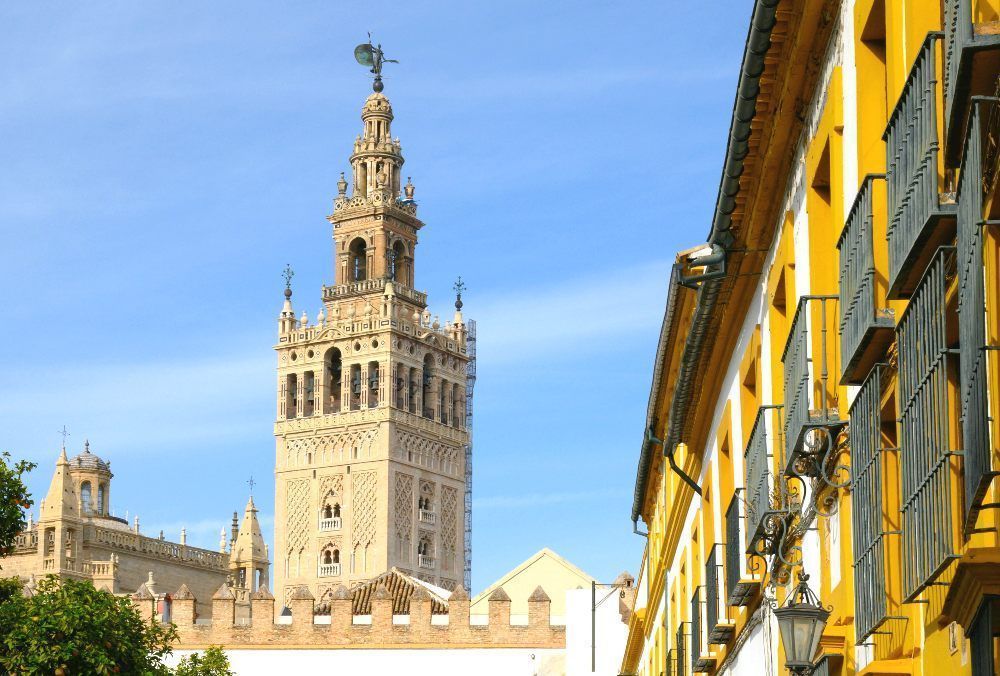
🕌 The Giralda
The lower part of the Giralda was originally built as the minaret of the Almohad mosque. Its brick decoration, ramps and monumental proportions reveal the ambition of Islamic Seville.
After the Christian conquest, the minaret was preserved and transformed into the bell tower of the Cathedral. It is therefore one of the clearest examples of cultural continuity and religious change in the city.
🏰 The Royal Alcázar
The Royal Alcázar occupies an area used for palatial and defensive purposes during the Islamic period.
Its present appearance includes Islamic, Gothic, Mudéjar, Renaissance and later elements. The Palace of King Pedro I is especially important for understanding how Islamic artistic language continued to be used by Christian monarchs.
🧱 Walls, streets and urban memory
Other Islamic traces include sections of the historic walls, towers, former gates, hidden baths, reused columns and the irregular layout of certain streets.
The influence of Islamic architecture also survived in the Mudéjar tradition, in which Muslim craftsmen and techniques contributed to buildings created under Christian rule.
☪️ Giralda: an Almohad minaret transformed into a Christian bell tower.
🏰 Alcázar: a complex palace where Islamic and Christian traditions overlap.
🧱 Urban traces: walls, towers, baths, gates and irregular streets.
🎨 Mudéjar art: Islamic techniques and decoration used in Christian buildings.
✝️ Christian Seville
Christian forces conquered Seville in 1248 under King Ferdinand III of Castile. From that point, the religious, political and social organisation of the city changed profoundly.
Mosques were converted into churches, new convents and parishes were founded and the city gradually became one of the principal Christian centres of the Crown of Castile.
⛪ The Cathedral of Seville
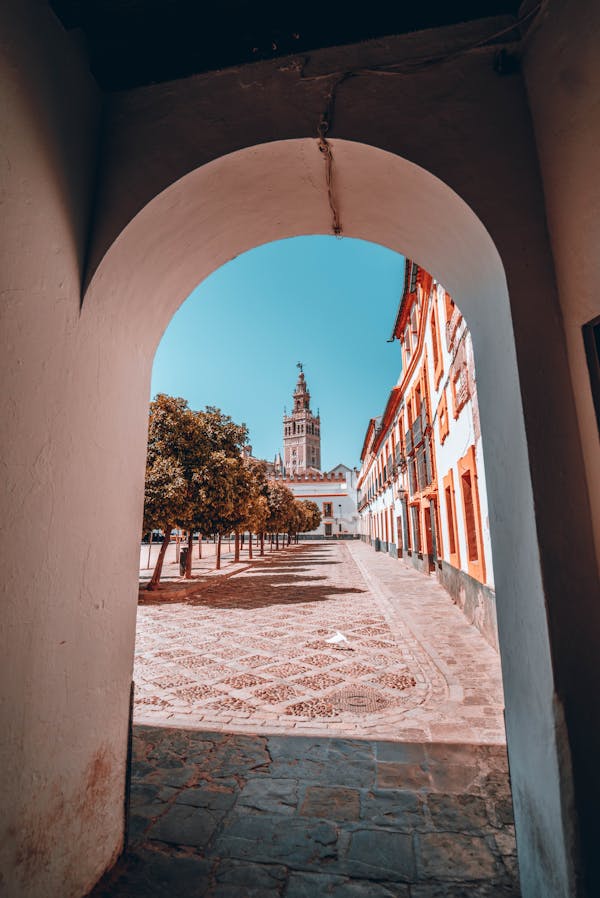
The Cathedral of Seville was constructed on the site of the former Almohad mosque. Parts of the earlier Islamic complex were preserved, including the Giralda and the courtyard now known as the Patio de los Naranjos.

The enormous Gothic building symbolises the political and religious importance of Christian Seville. Its chapels, tombs, paintings and sculptures also reflect the wealth accumulated during later centuries.
👑 The Christian Alcázar
The Alcázar remained a royal residence after the Christian conquest. Gothic and Renaissance palaces were added, while Islamic-inspired decoration continued to be commissioned by Christian rulers.
This mixture makes the Alcázar one of the best places to explain why cultural history is often more complex than a simple succession of separate periods.
⛪ Churches and convents
Throughout the historic centre, churches and convents occupy sites connected with earlier mosques, synagogues, noble residences and medieval institutions.
The Christian city also developed a powerful artistic tradition that reached its height during the Baroque period, with painters and sculptors such as Murillo, Zurbarán, Martínez Montañés and Juan de Mesa.
✡️ Jewish Seville
Seville had an important Jewish community during the Middle Ages. Its members participated in commercial, intellectual, medical and administrative life, although their position was often vulnerable and depended on changing political circumstances.
The old Jewish quarter extended through areas now associated with Santa Cruz and San Bartolomé.

🏘️ Santa Cruz and San Bartolomé
The narrow streets of Santa Cruz form the best-known part of the former Jewish quarter, although much of its present appearance was shaped by later urban reforms.
San Bartolomé is generally quieter and preserves a more local atmosphere, with historic houses, palaces, churches and streets connected with the medieval Jewish district.
⛪ Santa María la Blanca
The Church of Santa María la Blanca occupies a site traditionally associated with a medieval synagogue.
The building was later converted into a Christian church and transformed again during the Baroque period. It is an excellent example of how the religious identity and artistic appearance of a building can change over time.
⚖️ Persecution and expulsion
The history of Jewish Seville also includes discrimination, forced conversion, violence and expulsion.
The attacks of 1391 had devastating consequences for the Jewish community. The expulsion ordered in 1492 completed a process of rupture that had already transformed the neighbourhood and its population.
✡️ A necessary perspective: the Jewish quarter should not be presented only as a picturesque setting. Its beauty coexists with the memory of a community that suffered persecution, forced conversion and expulsion.
🚶 The two-hour panoramic route
The panoramic route is a 100% outdoor private tour designed to provide a clear introduction to the three cultural traditions.
The exact itinerary may vary according to the meeting point, religious services, street conditions and the interests of the group.
📍 Possible highlights
☪️ Exterior of the Giralda: origin as the minaret of the Almohad mosque.
✝️ Cathedral surroundings: transformation from mosque to Christian cathedral.
🏰 Alcázar exterior: Islamic origins and later Christian palace.
✡️ Santa Cruz: streets and spaces connected with the old Jewish quarter.
⛪ Santa María la Blanca: memory of the synagogue and later Christian church.
🏘️ San Bartolomé: the quieter and less touristy part of the Jewish district.
This option is ideal for visitors who have limited time, prefer not to enter monuments or have already visited the principal interiors.
🚶 Panoramic Three Cultures Route
⏱️ 2 hours
🌤️ 100% outdoor route
👥 Private tour for up to 8 people
💶 Total price: €150
🏰 The extensive four-hour route
The extensive route is designed for visitors who want to enter the principal monuments and understand how their architecture reveals the succession and interaction of cultures.
The route can include the Cathedral and Giralda, the Royal Alcázar and a walk through the old Jewish quarter.
⛪ Cathedral and Giralda
Inside the Cathedral, the guide explains the Christian transformation of the former mosque, the preservation of the minaret and courtyard and the development of the Gothic building.
🏰 Royal Alcázar
The Alcázar allows visitors to observe Islamic remains, Mudéjar decoration commissioned by Christian monarchs, Gothic rooms and later Renaissance additions.
✡️ Jewish quarter
The route continues through Santa Cruz and other streets associated with the Jewish community, explaining both the historical evidence and the later legends attached to the neighbourhood.
🏰 Extensive Three Cultures Route
⏱️ 4 hours
🎟️ Interior visits to monuments
👥 Private tour for up to 8 people
💶 Total price: €250 + tickets
💬 Contact Ignacio to organise the route
✉️ info@visitarsevilla.com
🎟️ Important: monument tickets are not included in the guide price. Availability and entrance times must be coordinated before confirming the final itinerary.
👩🏫 Why take this route with a specialist guide?
The monuments can be admired independently, but the relationship between the three cultures is not always visible without explanation.
🧱 Read the buildings: recognise Islamic structures hidden inside later Christian monuments.
✡️ Understand Jewish Seville: go beyond the picturesque image of Santa Cruz.
☪️ Identify Islamic heritage: distinguish original Almohad elements from later Mudéjar decoration.
✝️ Explain Christian transformation: understand how mosques, synagogues and palaces changed function.
⚖️ Avoid oversimplification: explore coexistence, cultural exchange, conquest and persecution with historical context.
🗺️ Connect the city: relate monuments, streets and neighbourhoods within a coherent historical narrative.
👨👩👧👦 Who is the Three Cultures Route for?
The route is suitable for a wide variety of visitors because it can be adapted in depth, pace and language.
💑 Couples: a private cultural experience through the historic centre.
👨👩👧👦 Families: explanations adapted to the ages and interests of the group.
🎓 Students and teachers: useful for history, art, religion and cultural studies.
🏛️ Architecture enthusiasts: explore Islamic, Gothic, Mudéjar and Renaissance layers.
✡️☪️✝️ Religious and cultural groups: a balanced introduction to the three traditions.
🌍 First-time visitors: an excellent way to understand the identity of Seville.

💡 Practical advice
🎟️ Reserve early: the Alcázar and Cathedral may sell out during busy periods.
👟 Wear comfortable shoes: both formats involve substantial walking.
🌡️ Consider the weather: the panoramic route is completely outdoors.
🕰️ Allow enough time: security controls and monument entrances can affect the schedule.
👥 Tell us about your group: ages, mobility and interests help us adapt the visit.
📚 Choose your focus: history, architecture, religion, Jewish heritage or Islamic art.
⛪ Respect places of worship: access can occasionally change because of religious services.
⭐ Why organise the route with VisitarSevilla.com?
📍 Local knowledge: the route connects the monuments with the real historical geography of Seville.
👩🏫 Specialist guides: clear explanations of art, architecture, religion and social history.
👥 Completely private: the guide is dedicated only to your group.
⚖️ Balanced perspective: we explain cultural exchange without ignoring conflict and persecution.
🗺️ Flexible formats: choose a panoramic outdoor route or an extensive visit with monuments.
🎓 Adapted depth: suitable for general visitors, families, students and specialist groups.
💬 Direct contact: speak with Ignacio before confirming the most suitable option.
📖❓ Frequently asked questions about the Three Cultures Route
What are the three cultures of Seville? ▼
The route focuses on the Christian, Islamic and Jewish communities and traditions that shaped the history, architecture and identity of Seville.
Were the three cultures always peaceful? ▼
No. There were periods of coexistence and cultural exchange, but also conquest, discrimination, persecution, forced conversion and expulsion.
What is included in the panoramic route? ▼
It is a two-hour outdoor private walk exploring the principal visible traces of Christian, Islamic and Jewish Seville.
What is included in the extensive route? ▼
The four-hour route includes interior monument visits and a walk through areas connected with the three cultures. The precise itinerary depends on ticket availability.
Are monument tickets included? ▼
No. The €250 price covers the private guide for up to eight people. Monument entrance tickets are paid separately.
Is the tour completely private? ▼
Yes. Both formats are private tours with a guide dedicated only to your group of up to eight people.
Is the route suitable for children? ▼
Yes. The content and pace can be adapted to the ages of the children, although the four-hour route is more demanding.
Which route should I choose? ▼
Choose the two-hour route for a concise introduction or the four-hour route if you want to enter the monuments and explore the subject in greater depth.
Can the tour focus more on Jewish or Islamic heritage? ▼
Yes. As it is a private experience, the guide can give more attention to Jewish history, Islamic architecture or another specific interest.
How can I book the route? ▼
Write to info@visitarsevilla.com or contact us through WhatsApp, indicating your date, number of visitors and preferred route.
✡️☪️✝️ Discover the three cultures that shaped Seville
Explore the Islamic origins of the Giralda and Alcázar, the Christian transformation of the city and the memory of the medieval Jewish quarter.
Choose a two-hour panoramic walk or a four-hour private route with interior visits to the principal monuments.
💬 Ask Ignacio about the Three Cultures Route
✉️ info@visitarsevilla.com
📱 @visitarsevillacom
➡️ Jewish heritage tour of Seville
➡️ Santa Cruz and the old Jewish quarter
➡️ Private guided tours in Seville
Content prepared by VisitarSevilla.com, a local cultural tourism project active since 2014. Monument opening times, ticket availability, religious services and the precise itinerary may vary according to the date and operational conditions.


Leave a comment