

Last updated on July 31st, 2026
☪️ Islamic Heritage Tours in Seville: Discover the Legacy of Al-Andalus
☪️ How would you like to discover Islamic Seville?
Choose a completely private visit with one of our specialist guides or reserve an international group experience online.
🔐 Private Islamic Seville tours
We offer an outdoor introduction to the Muslim city and a more complete monumental tour including the Alcázar and the Islamic origins of the Cathedral and Giralda.
💬 Contact Ignacio on WhatsApp
✉️ info@visitarsevilla.com
🤝 Recommended Three Cultures walking tour:
Check prices and availability
An interesting alternative for visitors who want to explore the Muslim, Jewish and Christian layers of Seville within a shared historical route.
🕌 Islamic heritage tours in southern Spain:
Compare Islamic history and mosque tours
Discover excursions and cultural experiences connected with the great Andalusi heritage of Seville, Córdoba, Granada and other destinations in southern Spain.
📅 Booking advice: specialist guides and timed entrances to the Alcázar and Cathedral can sell out. For the monumental tour, contact us as early as possible.
📍 Islamic Seville: quick facts
🧭 Our private Islamic heritage tours
Our private formats are designed for visitors who want more than a general introduction to Seville.
The route explores the Muslim city, the transformations that followed the conquest of 1248 and the survival of Islamic architectural and urban traditions within Christian Seville.

🚶 Islamic Seville: private outdoor walking tour
A clear and accessible introduction to the Islamic city through surviving outdoor remains, medieval urban planning, walls, gates, towers and the transformation of Ishbiliya after 1248.
⏱️ Duration: 2 hours
👥 Private group: up to 8 people
💶 Price: €150
🎟️ Monument tickets: not required for the basic outdoor route
💎 Islamic Seville: private monumental tour
A more complete visit combining the historic city with major monuments. The route explains the Islamic origins of the Giralda and Cathedral complex and explores the Almohad and Mudéjar spaces of the Royal Alcázar.
⏱️ Duration: approximately 3.5 hours
👥 Private group: up to 8 people
💶 Price: €250
🎟️ Not included: monument tickets and compulsory audio equipment where applicable
👨👩👧👦 Tailor-made visits: the content and pace can be adapted for families, students, cultural associations, university groups and travellers with a particular interest in Islamic art or the history of Al-Andalus.

🕌 From Ishbiliya to Almohad Seville
Seville became part of Al-Andalus in the early 8th century. Over the following centuries, the city developed as an important commercial, political and cultural centre.
Its urban landscape included congregational mosques, neighbourhood mosques, markets, baths, palaces, gardens, defensive walls and sophisticated systems for supplying and managing water.
The city reached a particularly important stage under the Almohads. During the 12th century, Seville became one of the principal centres of their western territories, leading to major works of architecture, defence and urban infrastructure.
The great mosque, its minaret, the palatial complexes of the Alcázar, the Torre del Oro and important sections of the walls belong to this period or preserve substantial Almohad elements.
❤️ My perspective: Islamic Seville is not confined to a few monuments. It survives in the scale of the old city, the organisation of streets, the relationship between architecture and water, the preference for internal courtyards and the later development of Mudéjar art.

🔍 Essential Islamic heritage sites in Seville
1. 🕌 El Salvador and Seville’s first congregational mosque
The site occupied today by the Church of El Salvador was once home to Seville’s principal mosque before the construction of the great Almohad mosque beside the Alcázar.
The current complex preserves the historic courtyard, commonly known as the Patio de los Naranjos, and elements associated with the earlier minaret beneath the later bell tower.
Its location beside Plaza del Pan and the surrounding shopping streets also helps us understand the close relationship between the mosque and the commercial centre of the medieval city.

2. 🗼 The Giralda and the Almohad great mosque
The Cathedral of Seville stands on the site of the great congregational mosque built during the Almohad period.
The most important surviving structure is the Giralda. Most of the lower tower formed the minaret of the mosque, while the Renaissance bell chamber was added during the Christian period.
The decoration of the façades, the ramps inside the tower and its commanding position reveal the scale and ambition of Almohad Seville.
The Patio de los Naranjos also preserves the mosque courtyard, although it has undergone important transformations over the centuries.


🗼 Key idea: the Giralda is not merely influenced by Islamic architecture. Its principal body is the surviving minaret of the 12th-century Almohad mosque.
3. 👑 The Royal Alcázar
The Royal Alcázar is a complex formed over many centuries. Its history includes Islamic palatial spaces, Christian additions and the exceptional Mudéjar palace commissioned by King Pedro I.
Among the most significant Almohad remains is the Patio del Yeso, with its elegant plasterwork and arcade.
Other spaces, gardens, walls and archaeological remains help explain the development of the palatial quarter at the southern edge of the medieval city.
The palace of Pedro I was constructed after the Christian conquest, but Muslim craftsmen and Andalusi decorative traditions played a fundamental role in its design. It is therefore one of the great expressions of Mudéjar art rather than an unchanged Islamic palace.


4. 🧱 The walls and gates of Islamic Seville
Medieval Seville was protected by an extensive defensive system that was enlarged and reinforced during the Almoravid and Almohad periods.
The best-known surviving section runs through the Macarena district, between the Macarena and Córdoba gates.
Additional remains can be found around the Jardines del Valle, the Alcázar, Calle Agua, Murillo Gardens, Plaza del Cabildo and the Arenal.
The names of several modern streets and districts still preserve the memory of gates, walls and routes that organised access to the medieval city.


5. 🛡️ Torre de la Plata and the Arenal defences
The Torre de la Plata formed part of the defensive system protecting the riverfront and the southern approaches to the city.
It was connected with other walls and towers in the Arenal, including the Torre del Oro.

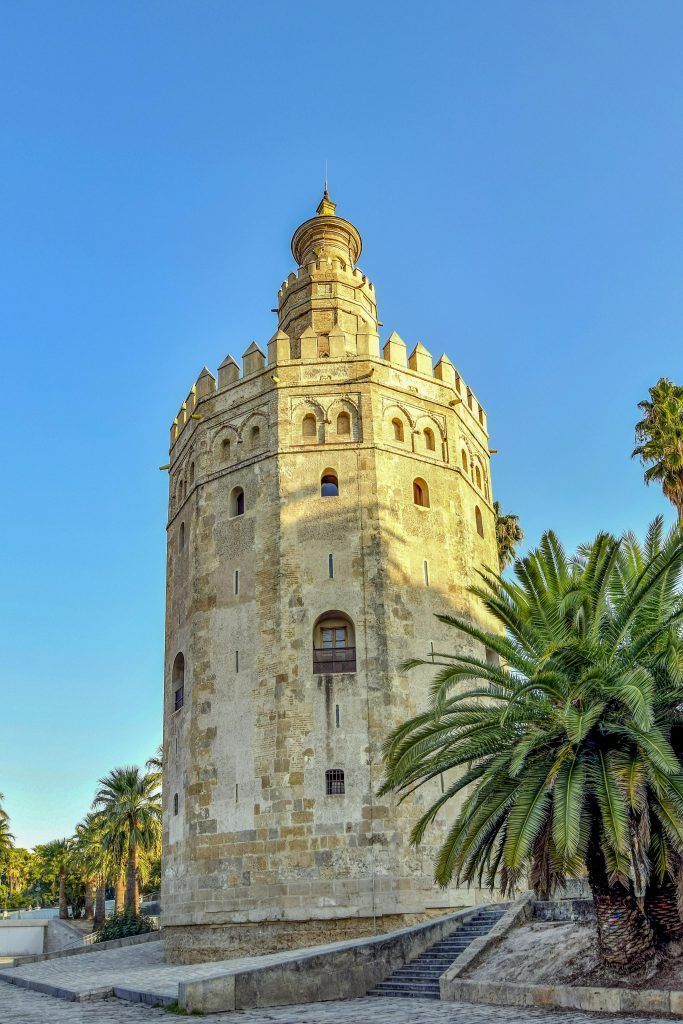
6. 🗼 Torre del Oro
The first and largest section of the Torre del Oro was constructed during the Almohad period in the early 13th century.
Its strategic position allowed it to protect the Guadalquivir riverfront and the access to the Arenal.
The tower was connected to the wider defensive system through walls extending towards the Alcázar and the Torre de la Plata.

7. 💧 Caños de Carmona and water management
The aqueduct traditionally known as the Caños de Carmona had Roman origins but was restored and adapted during the Islamic period.
It supplied water to parts of the city and to agricultural and palatial areas such as the Buhaira.
Water was essential to daily life, ritual practice, gardens, baths and the productive landscape surrounding medieval Seville.

8. 🌿 The Buhaira palace and gardens
The Buhaira preserves the memory of an Almohad suburban palatial and agricultural estate.
Its gardens and water infrastructure demonstrate the relationship between leisure, cultivation, architecture and hydraulic engineering in Al-Andalus.
Although the site has changed considerably, it remains useful for understanding how the medieval city extended beyond its walls.

🎨 From Islamic architecture to Mudéjar Seville
The Christian conquest of 1248 did not erase the city’s Islamic architectural culture.
Muslim craftsmen continued to work for Christian patrons, while forms such as horseshoe arches, geometric decoration, plasterwork, timber roofs, ceramic tiles and internal courtyards remained highly influential.
This process contributed to the development of Mudéjar architecture, one of the defining artistic traditions of medieval and early modern Seville.
Important examples can be seen in the Alcázar, the churches of San Marcos, Santa Marina and Omnium Sanctorum, the Church of Santa Ana in Triana and later palace houses such as Casa de Pilatos and Palacio de las Dueñas.


🎨 Important distinction: not every building with Islamic-looking decoration was built during Muslim rule. Many of Seville’s most beautiful spaces are Mudéjar works created under Christian patrons using techniques and aesthetics inherited from Al-Andalus.
🤝 Seville and the Three Cultures
The history of Seville cannot be understood through a single religious or cultural tradition.
Muslim, Jewish and Christian communities occupied the city at different times and under very different political conditions. Their histories include cultural exchange and artistic influence, but also conquest, inequality, forced conversion, expulsion and conflict.
A responsible Three Cultures route should therefore avoid presenting medieval coexistence as a permanently harmonious reality. Its real interest lies in understanding the complex relationships that helped shape the city.
🤝 Recommended: Seville Three Cultures History Walking Tour
This guided experience explores the Muslim, Jewish and Christian layers of Seville and is a good option for visitors seeking a shared group tour with a broad historical perspective.
🗺️ What might an Islamic Seville itinerary include?
The exact route depends on the duration, monument availability, opening times and interests of the group.
🕌 The old congregational mosques: El Salvador and the later Almohad mosque beneath the Cathedral.
🗼 The Giralda: its construction, decoration and transformation from minaret to cathedral bell tower.
👑 The Royal Alcázar: Almohad spaces, archaeological layers and the later Mudéjar palace.
🛍️ The commercial city: the old market area around El Salvador and Plaza del Pan.
🧱 Walls and towers: Macarena, Torre de la Plata, Torre del Oro and surviving gates.
💧 Water and gardens: Caños de Carmona, Buhaira and the role of water in palatial architecture.
🎨 Mudéjar continuity: churches, palaces, courtyards, plasterwork and tiles created after 1248.
🕌 Islamic heritage beyond Seville
Seville is an excellent starting point for exploring the wider legacy of Al-Andalus in southern Spain.
Córdoba preserves the extraordinary former Great Mosque, while Granada offers the Alhambra, Generalife and Albaicín. Other cities and towns contain fortresses, baths, archaeological remains and historic urban landscapes connected with the Islamic period.
🚌 Islamic heritage tours in southern Spain
Compare guided visits, mosque tours and excursions connected with the Islamic history of Seville, Córdoba, Granada and other Andalusian destinations.
👨👩👧👦 Who is this tour suitable for?
☪️ Travellers interested in Islamic heritage: visitors who want a respectful and detailed explanation of the city’s Andalusi past.
🎨 Art and architecture enthusiasts: travellers interested in Almohad and Mudéjar forms, materials and decoration.
👨👩👧👦 Families: the route and explanations can be adapted to the ages of the children.
🎓 Students and academic groups: visits can focus on history, archaeology, urbanism or intercultural relations.
🕌 Muslim visitors: the tour provides historical and cultural context for important sites connected with Al-Andalus.
🤝 Interfaith and cultural groups: routes can explore the complex relationships between Muslim, Jewish and Christian Seville.
⭐ Why book with VisitarSevilla.com?
📍 Local project: VisitarSevilla.com has been active since 2014.
☪️ Specialist subject: visits focused specifically on Islamic Seville and its later artistic legacy.
👩🏫 Private guides: the experience is reserved for your party and adapted to your interests.
📚 Historical context: monuments are explained within the political, urban and cultural history of Al-Andalus.
🤝 Respectful approach: the route recognises the importance of Islamic heritage without simplifying Seville’s complex history.
💬 Direct contact: speak with Ignacio before choosing the most suitable format.
☪️ Reserve a private Islamic heritage tour
Tell us your preferred date, number of visitors, language and whether you prefer the two-hour outdoor route or the complete monumental experience.
For larger groups, educational visits or special interests, ask us for a personalised proposal.
💬 Contact Ignacio on WhatsApp
✉️ info@visitarsevilla.com
📱 @visitarsevillacom
📖❓ Frequently asked questions about Islamic heritage tours in Seville
What will I see on an Islamic Seville tour? ▼
Depending on the chosen format, the route may include the Giralda, Cathedral mosque courtyard, Alcázar, El Salvador, medieval walls, defensive towers and Mudéjar monuments.
How long was Seville under Muslim rule? ▼
Seville formed part of Al-Andalus from 711 until its conquest by Ferdinand III of Castile in 1248.
Was the Giralda originally a minaret? ▼
Yes. Most of the lower structure formed the minaret of the 12th-century Almohad congregational mosque. The upper bell chamber was added during the Christian period.
Is the Cathedral built on a mosque? ▼
The Gothic Cathedral was constructed on the site of the Almohad congregational mosque. The Giralda and much of the Patio de los Naranjos preserve important parts of the earlier complex.
Is the Alcázar an Islamic palace? ▼
The Alcázar includes genuine Islamic and Almohad structures, but it developed over many centuries. Its famous Palace of Pedro I is a Christian royal palace built in the Mudéjar tradition with the participation of Muslim craftsmen.
What is Mudéjar architecture? ▼
Mudéjar architecture developed under Christian rule while using techniques, forms and decorative traditions strongly influenced by Islamic art.
How long do your private tours last? ▼
The outdoor introduction lasts two hours. The monumental tour combining the city with the Alcázar and Cathedral area lasts approximately three and a half hours.
How much does the private outdoor tour cost? ▼
The two-hour private outdoor tour costs €150 for a group of up to eight people.
How much does the monumental tour cost? ▼
The approximately 3.5-hour private monumental tour costs €250 for up to eight people. Entrance tickets and compulsory audio equipment are not included.
Are the monument tickets included? ▼
No. Tickets to the Royal Alcázar and Cathedral are purchased separately. We can advise you about the correct entrances and times.
Can the tour be adapted for Muslim travellers? ▼
Yes. The route can place particular emphasis on the history, architecture and cultural memory of Islamic Seville while maintaining a rigorous historical approach.
Is the tour suitable for children? ▼
Yes. A private tour can adapt the explanations, pace and number of stops to the ages and interests of the children.
Can you organise tours for schools or universities? ▼
Yes. Contact us with the group size, educational level, preferred date and academic focus so that we can prepare a proposal.
What is the Three Cultures tour? ▼
It is a guided route exploring the Muslim, Jewish and Christian historical layers of Seville. We recommend a reservable group option for visitors seeking this broader perspective.
Can I visit Córdoba or Granada from Seville? ▼
Yes. Various day trips and guided tours connect Seville with Córdoba, Granada and other important destinations associated with Al-Andalus.
How can I reserve a private tour? ▼
Write to info@visitarsevilla.com or contact Ignacio through WhatsApp, indicating your date, group size and preferred tour.
☪️ Discover the Islamic heritage of Seville
Explore the Giralda, Alcázar, ancient mosque sites, walls, towers, gardens and Mudéjar monuments with a specialist private guide.
Contact us directly or compare our selected group tours and excursions through southern Spain.
💬 Ask Ignacio about a private Islamic Seville tour
✉️ info@visitarsevilla.com
➡️ Seville Cathedral and its heritage
➡️ Granada and the Alhambra from Seville
➡️ Private guided tours in Seville
➡️ Triana: history and cultural heritage
Content prepared by VisitarSevilla.com, a local cultural tourism project active since 2014. Monument opening times, ticket conditions, prices and access arrangements may change. Historical buildings in Seville often combine elements from different periods, and the tour explains these successive transformations in their proper context.


Brilliant information – thank you!